
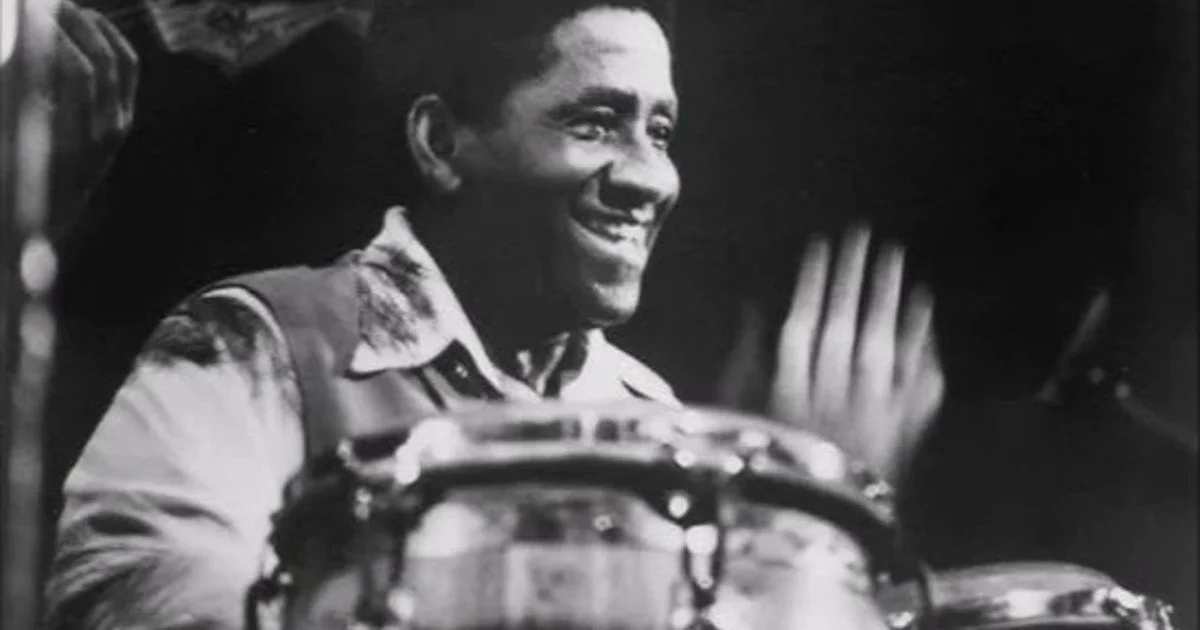
1917–2003 · Havana, Cuba
The Cuban conguero who took the conga to the American pop charts with "Watermelon Man" and wrote "Afro Blue," a Latin jazz standard.
- Played with
- Tito Puente, Cal Tjader, Pérez Prado, Herbie Hancock
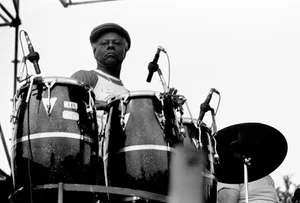
Ramón "Mongo" Santamaría grew up in Jesús María, a working-class neighborhood in Havana with deep Afro-Cuban roots. Rumba, bembé and Santería drumming filled its streets. His mother wanted him to play the violin, but it was the drums that pulled him in. Few congueros have had as big an impact outside the world of Latin music. Mongo played with Pérez Prado, Tito Puente and Cal Tjader, and he wrote a jazz standard of his own, "Afro Blue." In 1963 his version of Herbie Hancock's "Watermelon Man," a conga-led single, went all the way to No. 10 on the Billboard Hot 100.
From Jesús María to New York
Mongo was born on April 7, 1917. He dropped out of school in his teens to become a musician. For a while he worked as a mailman during the day and played the legendary Tropicana at night. In 1937 he joined the Septeto Boloña, and he later worked with Conjunto Matamoros. Through the '40s he was a regular on the Havana club scene.
Then, in 1948, he and fellow conguero Armando Peraza headed for Mexico City. There Mongo played drums for a dance act's stage show and worked with bandleader Pérez Prado. Around 1950 the two of them settled in New York, right in the middle of the mambo craze.
One of Mongo's first gigs in town was with bandleader Gilberto Valdés, in what's considered the first charanga band in New York. After another stint with Prado, he joined Tito Puente's band and stayed most of the decade. At the height of the mambo, he and Tito entertained crowds with their percussion battles. You can hear him on Tito's Puente in Percussion (Tico, 1956).
In the late '50s Mongo headed west to San Francisco to join vibraphonist Cal Tjader's Latin jazz group, alongside timbalero Willie Bobo. Those three years introduced him to jazz audiences all over the country.
A Rumbero at Heart
All through those years, Mongo also recorded the music he grew up with. In the mid-'50s he made Changó (later reissued as Drums and Chants), an album of Afro-Cuban religious drumming and chants. His first album for Fantasy, Yambú (1958), was rumba through and through, with Francisco Aguabella and Modesto Durán on drums next to him. Bembé (1960) brought more folkloric drumming with religious chants.
Afro Blue
By then he was writing music of his own. In 1959 Mongo wrote "Afro Blue," even though, as he told DRUM! Magazine, he didn't know how to write music. He sang the melody to his pianist, Lonnie Hewitt, who wrote it down for him. It was one of the first jazz standards built on an African cross-rhythm. John Coltrane, Abbey Lincoln, Dizzy Gillespie and countless others went on to record it.
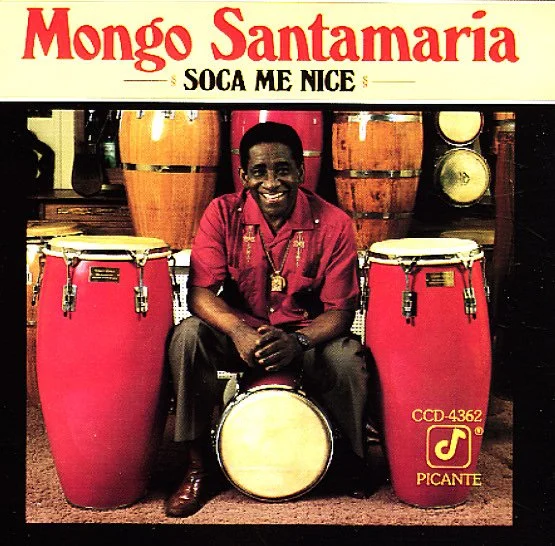
The cover of Mongo’s album Soca Me Nice
Watermelon Man
By the early '60s Mongo was leading his own band in New York, with a young Chick Corea on piano. One night in 1962, Herbie Hancock filled in for Corea and played a tune of his called "Watermelon Man." Mongo worked up his own version. In 1963 the single climbed to No. 10 on the Billboard Hot 100, helping bring the sound of the conga to American pop audiences.
Later Years
Mongo kept leading his own bands through the '60s and '70s, blending Cuban rhythms with jazz, soul and R&B on records like Stone Soul (Columbia, 1969). He played with the Fania All-Stars and, in the late '70s, recorded for Fania's label Vaya. He kept recording into the '90s, until health problems finally kept him off the road.
Timeline
1917Born April 7 in Jesús María, Havana
1937Joins the Septeto Boloña
1948Goes to Mexico City with Armando Peraza
Around 1950Settles in New York; soon joins Tito Puente's band
1958Yambú, his first album for Fantasy
1959Writes "Afro Blue"
1963"Watermelon Man" reaches No. 10 on the Billboard Hot 100
1978Amanecer wins the Grammy for Best Latin Recording
2003Dies in Miami on February 1, at 85
Selected Recordings
Afro-Cuban Drums (1952): early recordings of rumba and folkloric drumming.
Puente in Percussion, with Tito Puente (Tico, 1956): from Mongo's years in Tito's band.
Changó (mid-1950s): Afro-Cuban religious drumming and chants, later reissued by Vaya as Drums and Chants.
Yambú (Fantasy, 1958): his first album for Fantasy, with Francisco Aguabella and Modesto Durán among the drummers.
Mongo (Fantasy, 1959): includes his recording of "Afro Blue."
Bembé (1960): Afro-Cuban folkloric drumming with religious chants.
Watermelon Man! (Battle, 1963): recorded in New York in December 1962; the title track reached No. 10 on the Billboard Hot 100.
Mongo at the Village Gate (Riverside, 1963): a live record from the New York club.
Stone Soul (Columbia, 1969): from his years recording for Columbia.
Sofrito (1976): nominated for the Grammy for Best Latin Recording.
Amanecer (Vaya, 1977): won the Grammy for Best Latin Recording.
Awards & Recognition
His 1977 album Amanecer won Best Latin Recording at the 1978 Grammy Awards. Mongo was nominated six more times between the 1970s and 1980s, including for Sofrito and for Summertime with Dizzy Gillespie. In 1998 his recording of "Watermelon Man" was inducted into the Grammy Hall of Fame. The Smithsonian's National Museum of African American History and Culture holds a 1979 photograph of him and his Stone Soul album cover in its collection.
Legacy
Looking back, Mongo kept it simple. "I'm not a hero," he told Down Beat in 1999, "but I did my best to make everybody happy."
Mongo influenced a generation of percussionists. The New Grove Dictionary of Jazz credits him and his peers with being "in large part responsible for the gradual absorption of Latin rhythms into black music," and his bands were a proving ground for players like Chick Corea and Hubert Laws. "His band was like a school for so many musicians who passed through it," his son said. Few congueros ever reached as far: a jazz standard, a Top 10 pop hit and a recording in the Grammy Hall of Fame, all from the kid who chose the drums of Jesús María over the violin.
Mongo took the conga from the streets of Havana to the pop charts. If his story has you inspired to pick up the drums yourself, CongaChops.com is a great place to start.
Start your 7-day free trialRisk free. Cancel anytime.
More Percussion Profiles
 Tito Puente
 Armando Peraza