
Armando Peraza (1924–2014) was one of the most traveled and widely heard percussionists in the history of Latin music — a Cuban master of conga and bongo whose career spanned nearly seven decades and ranged from Havana's conjunto scene to the bebop sessions of Charlie Parker, the jazz stages of George Shearing and Cal Tjader, and ultimately the stadiums of Carlos Santana. Equally celebrated on both the conga drum and the bongó, Peraza brought an unorthodox, lightning-fast technique and an extraordinary musical adaptability to every context he stepped into.
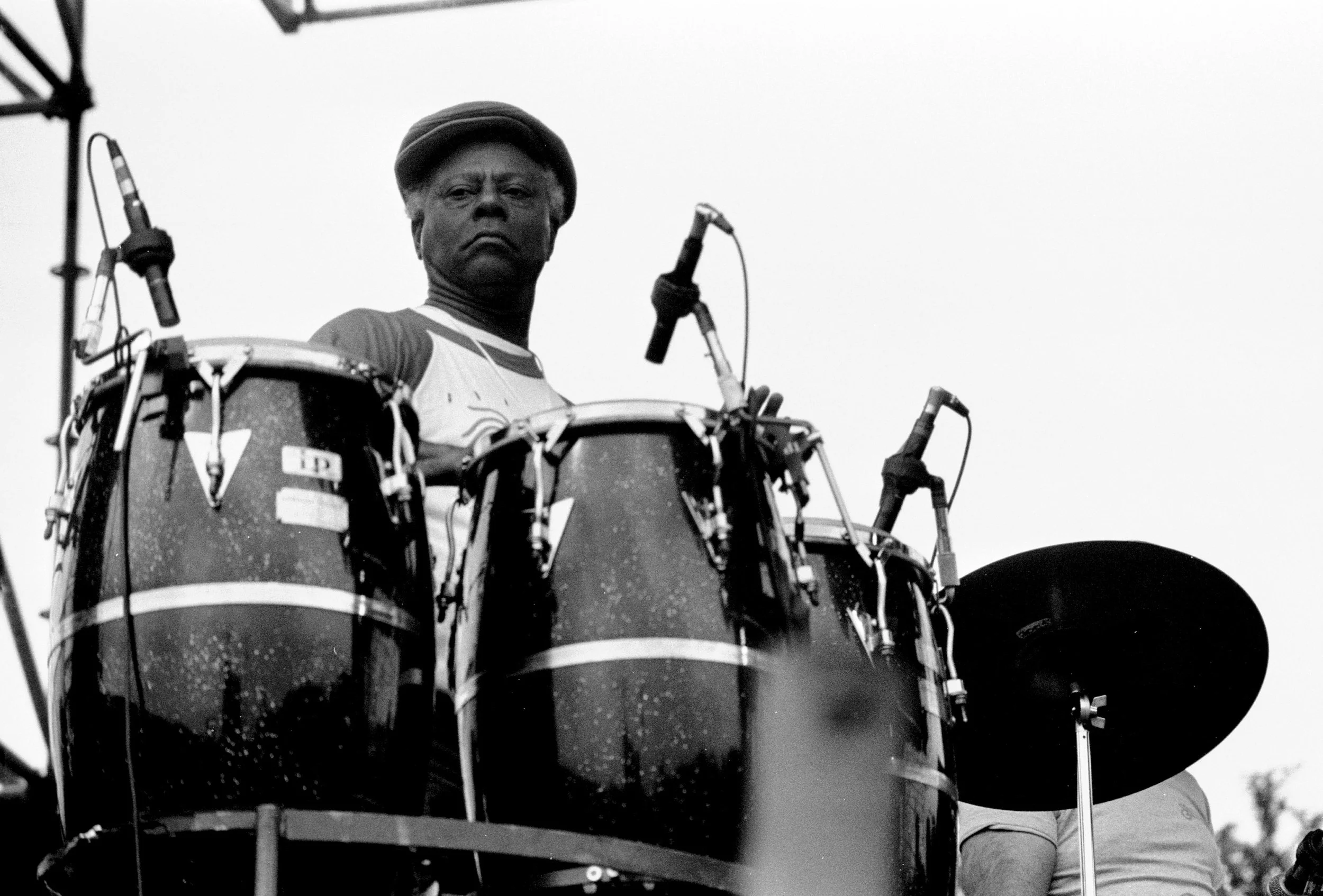
By Heinrich Klaffs
FROM THE STREETS OF HAVANA TO THE WORLD STAGE
Armando Peraza was born on May 30, 1924, in the Lawton Batista neighborhood of Havana, Cuba. Orphaned by the age of seven, he spent his early years on the streets, supporting himself through baseball, boxing, and odd jobs — with no formal musical training of any kind. His entry into music came entirely by chance, when a meeting at a baseball game led to an audition with bandleader Alberto Ruiz. He won the spot with no prior experience, and from there his development was rapid. By the late 1940s he was playing with Conjunto Kubavana alongside his close friend Carlos “Patato” Valdés, already establishing himself as one of the more compelling young percussionists on the Havana scene.
In 1948, Peraza left Cuba for Mexico alongside his close friend Mongo Santamaría, and the two arrived together in New York City in 1949 — part of the first wave of Cuban percussionists to bring authentic Afro-Cuban rhythms directly to the American jazz and popular music scenes. His New York debut made an immediate impression: after sitting in with Machito's big band, he was personally invited by Charlie Parker to participate in a recording session. A subsequent recording with Slim Gaillard produced a celebrated performance on “Bongo City” that remains a document of his early virtuosity. He eventually settled in San Francisco, where he would spend the rest of his life, and went on to record and perform with Dizzy Gillespie, Charles Mingus, Dexter Gordon, and Pérez Prado, among many others.
His twelve-year collaboration with pianist George Shearing — from the mid-1950s through the late 1960s — brought Peraza to international audiences and established him as a composer as well as a performer, with twenty-one original compositions entering the Shearing songbook. His work with vibraphonist Cal Tjader, beginning with the landmark Ritmo Caliente (1954), helped define the sound of West Coast Afro-Cuban jazz. In 1972, at the age of forty-seven, he joined Carlos Santana's band — a role he would hold for nearly twenty years — bringing Afro-Cuban percussion to one of the largest audiences in rock music history and co-writing sixteen songs recorded by the band, including “Gitano” from the 1976 album Amigos.
A SET OF TRAVELED HANDS
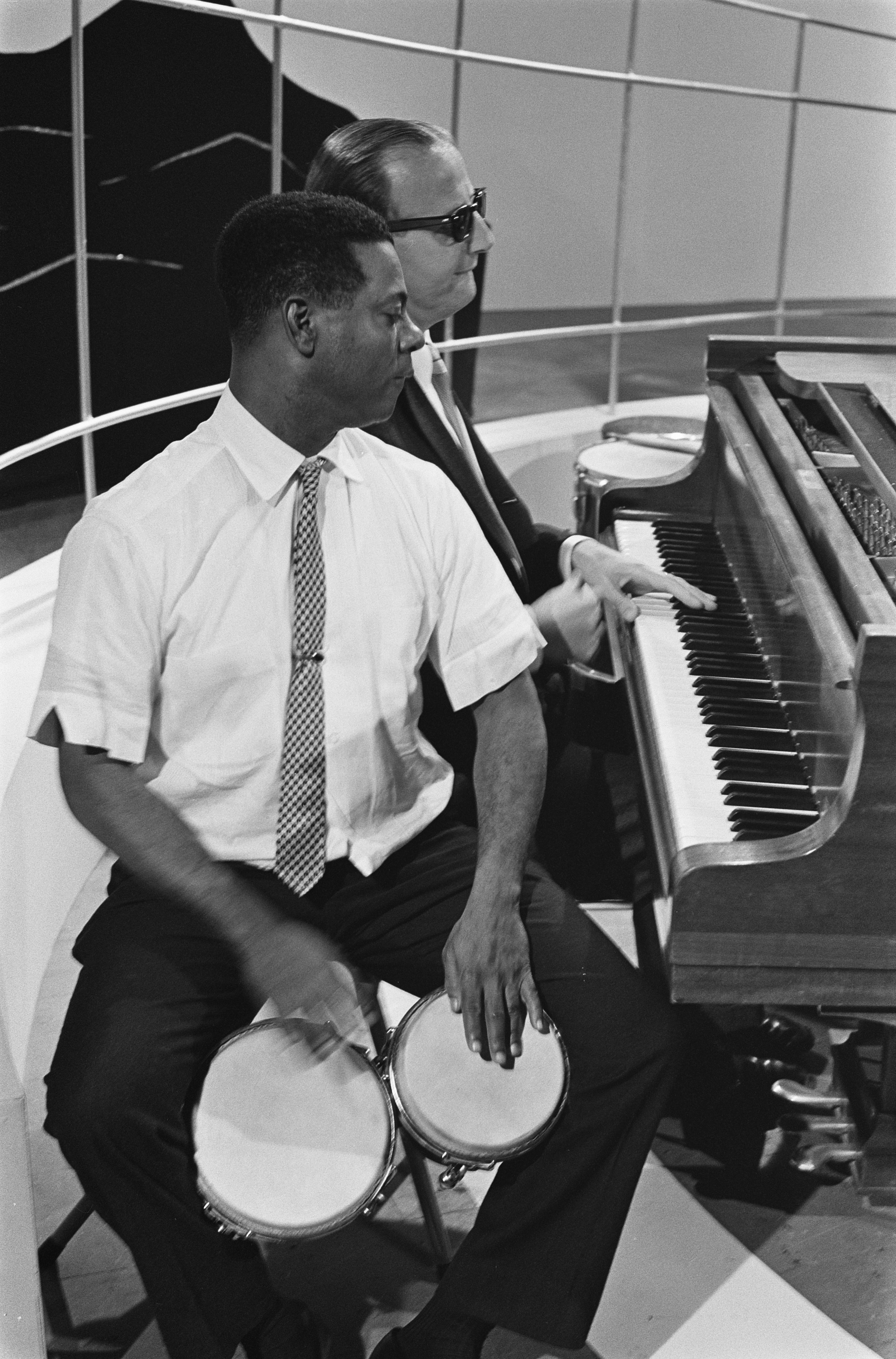
Peraza and George Shearing - By Hugo van Gelderen
What set Armando Peraza apart from his contemporaries was a combination of raw physical speed, unorthodox self-taught technique, and an openness to musical contexts that few percussionists of his generation could match. Described by fellow percussionist John Santos as perhaps the greatest bongocero in the history of the instrument, Peraza possessed a lightning-fast touch and a rhythmic dexterity that made him equally formidable on conga and bongó. His approach was deeply rooted in the Afro-Cuban tradition — he cited Tata Güines and Chano Pozo among his key influences, and even replaced Chano Pozo in Dizzy Gillespie's band — yet he moved through jazz, pop, and rock with a natural ease that belied any sense of stylistic limitation.
Among the earliest Afro-Cuban percussionists to bring conga drums to a rock recording, he appeared on Harvey Mandel's Cristo Redentor in 1968 — a milestone that anticipated his later role in Santana's genre-blurring sound. Throughout his career he recorded with Charlie Parker, Art Tatum, Dave Brubeck, Eric Clapton, Aretha Franklin, Jaco Pastorius, and Frank Zappa, among dozens of others. That breadth of recorded work, across virtually every genre of popular and improvisational music, speaks to a percussionist who was not only technically formidable but genuinely musical in the deepest sense.
SELECTED RECORDINGS
1954 – Ritmo Caliente (Cal Tjader, Fantasy Records): The recording that introduced Peraza to West Coast jazz audiences and helped establish the blueprint for Afro-Cuban jazz on the West Coast.
1964 – Soul Sauce (Cal Tjader, Verve): Features “Guachi Guaro,” the single that won Peraza a Grammy Award in 1965.
1968 – Wild Thing (Skye Records): Peraza's only album as a leader, featuring Chick Corea on piano and Johnny Pacheco on flute.
1973 – Welcome (Santana, Columbia): Features Peraza's celebrated conga solo on “Mother Africa,” one of the most striking examples of Afro-Cuban percussion in a rock setting.
1981 – Zebop! (Santana, Columbia): A high point of Peraza's later years with the band, featuring his powerful conga work on “Hannibal.”
AWARDS & RECOGNITION
Peraza's recording of “Guachi Guaro” with Cal Tjader won a Grammy Award in 1965. In 2007, he received a Lifetime Achievement Award from the Voices of Latin Rock, presented to him by Carlos Santana himself at a tribute concert in San Francisco. The organization continues to honor his legacy each January with the Armando Peraza Award, given for outstanding achievement in the San Francisco Bay Area music community — a fitting tribute to a percussionist whose adopted hometown never stopped celebrating him.
LEGACY
Peraza remained active well into his eighties, holding workshops, appearing at jazz festivals, and returning to Santana's stage for a rare reunion performance at the Montreux Jazz Festival in July 2006. He passed away in San Francisco on April 14, 2014, at the age of 89, having spent more than sixty years performing and recording with an almost unmatched range of musical icons. Few percussionists in history can claim a body of work that runs from Charlie Parker and Dizzy Gillespie through George Shearing and Cal Tjader to Carlos Santana and Eric Clapton — a span that makes Armando Peraza, by nearly every account, the most traveled and widely heard percussionist of his era.
Armando Peraza's story is proof that the conga and bongó can take you anywhere. If his journey has you inspired to start your own, CongaChops.com is the best place to begin.

START YOUR FREE TRIAL TODAY