
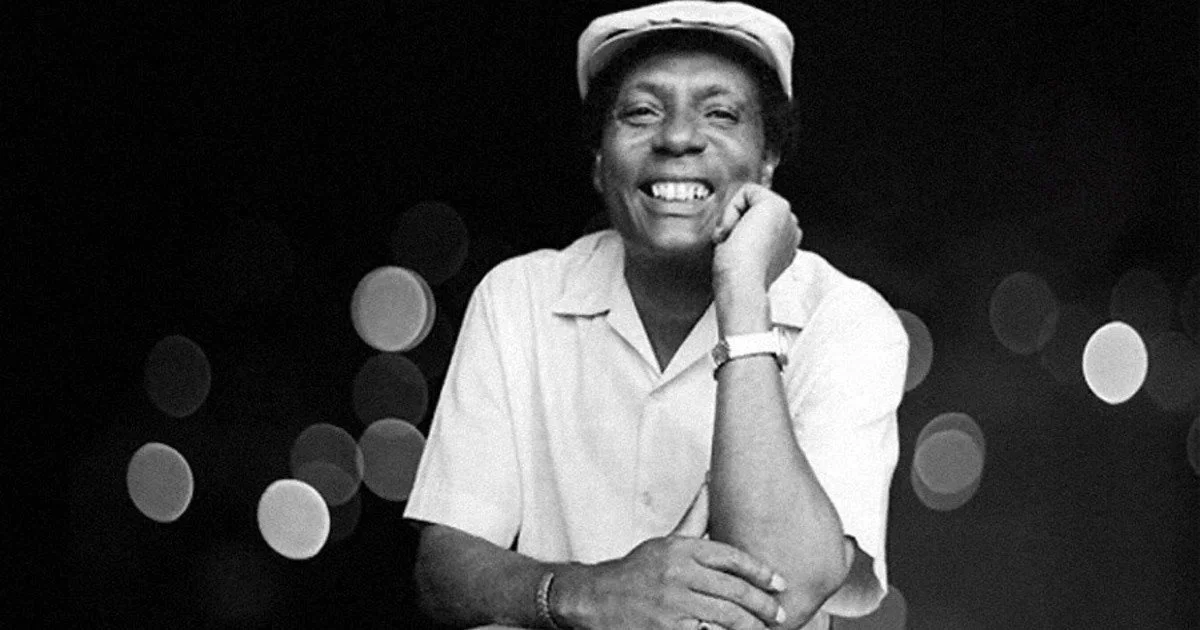
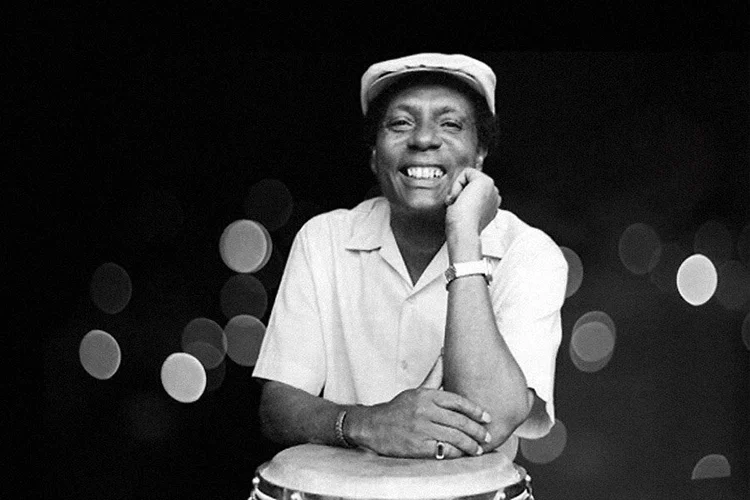
1930–2008 · Güines, Cuba
The Cuban conguero known as the King of the Congas and Manos de Oro, "Golden Hands," who helped shape modern conga playing.
- Played with
- Cachao, Chico O'Farrill, Frank Emilio Flynn, Dizzy Gillespie
Cuban master conguero Tata Güines is hailed as the godfather of modern conga playing. His crisp and unique sound, rhythmic vocabulary and technical innovations, as well as his prolific body of recorded work, have had an immeasurable impact, however direct or indirect, on every conga player over the past 70 years.
A Life of Rumba, Latin Jazz, and Tumbadora
The future “King of Congas” was born Federico Aristides Soto Alejo on June 30, 1930. Tata Güines grew up in pre-revolutionary Cuba, hailing from the poor, predominantly black town of Güines, just an hour south of Havana. Born into a musical family, a young Tata Güines constructed his own home made percussion instruments, including a bongo made from sausage and milk cans, to jam alongside his father, who played the Cuban tres. Tata’s passion for music was undeniable, though after dropping out of school at a young age he often had to take odd jobs to support himself, including as a shoeshine boy, newsboy, and windshield wiper.
Eventually, Tata Güines began playing double bass with local dance bands before switching to percussion. In 1948 Tata moved to Havana to become a full-time musician, and went on to work with musicians such as Bebo Valdés, Chico O’Farrill, Chano Pozo, and Arsenio Rodríguez, before joining the charanga band Fajardo Y Sus Estrellas, with whom he went on tour in South America and the United States. During the mid 1950’s, Tata Güines was part of the rhythm section of many influential recordings, most notably Cachao’s “Cuban Jam Sessions,” or “Descargas Cubanas” albums. Outside of Cuba, these recordings were particularly impactful on the young generation of Nuyorican musicians who eventually became the movers and shakers in the New York Salsa scene that would blossom in subsequent decades. On these recordings Tata Güines’ playing has become a timeless reference for every aspiring conguero, as many of his unique phrases and vocabulary can be heard in all of their effortless beauty. The phrase he plays at the beginning of the track “Descarga Cubana,” is just one of a multitude of classic phrases that have been an integral part of every serious conga player’s vocabulary ever since the records became popular.
In 1957, Tata Güines made the move to New York City, and became known around town as a prominent conga drum virtuoso, performing and recording with Chico O’Farrill, Cachao, and Machito, among others. Like his hero Chano Pozo before him, Tata often played with a host of legendary American jazz musicians, sharing the stage with Frank Sinatra, Dizzy Gillespie, and Maynard Ferguson, among others. At Birdland he met Miles Davis. He gave solo shows at the Waldorf Astoria, playing five congas and singing, and recorded with Josephine Baker.
After the Cuban Revolution in 1959, Tata Güines eventually decided to return to Cuba. As a black Cuban living in the United States, he suffered from racial discrimination, saying in an interview “Fame did not exist beyond the stage. Once you left the stage, it was like the signs said ‘whites only.’”
Returning to Cuba meant a loss of opportunity to be heard on an international stage. The tense and cold relationship between the United States and Castro’s Cuba made it much harder for him to continue building his international fame and career. Nonetheless, Tata continued to perform and record in Cuba, throughout Eastern Europe and in pro-Castro Latin American countries.
Once back in Cuba, Tata Güines played with the Quinteto Instrumental de Música Moderna, a latin jazz group that pianist Frank Emilio Flynn and drummer Guillermo Barreto founded in 1958, with Tata among its original members. Tata would continue to play with Frank Emilio Flynn in a group called Los Amigos, including on the 1999 album “Ancestral Reflections,” in which a much older and more mature (musically speaking) Tata Güines can be heard in all his glory.
From his return to Cuba until his death on February 4, 2008, Tata continued to play and record with an array of the most prominent musicians on the island, including Orlando “Maraca” Valle, Silvio Rodríguez, Omara Portuondo, Elena Burke, ¡Cubanismo!, Hilario Durán, and Rubén González, among many, many others. Tata Güines also released several albums under his own name, notably the album entitled Pasaporte, which features collaborations with his most renowned disciple, Miguel “Anga” Diaz.
Tata Güines’ Musical Style and Innovations
Like many of his predecessors and contemporaries, Tata’s style drew heavily on the folkloric percussive environment of his upbringing. Though he is known primarily for his recordings in the Cuban Jazz genre, he considered himself first and foremost a rumbero. As he put it in a 2007 interview with the Cuban magazine Bohemia (in Jan Fairley's translation), "You must always take your own music into account, your own flag, as well as whatever else comes along." In his later years, Tata led his own rumba groups, and today his son, Tata Güines Jr., leads one that carries on his music. Tata’s rumba style can always be heard at the root of his soloing vocabulary, in which he channels the feel of Havana style Quinto playing, combined with his own flavor, musical shapes, and beautiful technique.
Tata Güines’ contributions to the evolution of the conga are literally endless. He is justly credited with pushing the boundaries of technique on the conga drum in new directions. Among these innovations, his development and use of the palm-tip in his left hand combined with a variety of strokes in his right hand, has gone on to be emulated and employed by countless other congueros of the time, as well as those that succeeded him. Tata also had a habit of keeping his fingernails long, to employ to create a wide variety of sounds and textures, that were uncommon in conga drumming, using the sound of the nail on skin to create a cata-like texture that he employed to great effect during his breathtaking and motivic unaccompanied conga solos.
The combination of these new techniques coupled with his speed and clarity, profound knowledge of different rhythms, and innate creative prowess to weave effortlessly between different shapes, sounds and ideas, gave way to some of the most exciting and awe-inspiring conga solos in recorded music history. Not to mention that Tata’s clear, powerful and pure tone is unmistakeable, and remains the golden standard for anyone learning how to play the congas.
5 Classic Tata Güines Tracks to Check Out
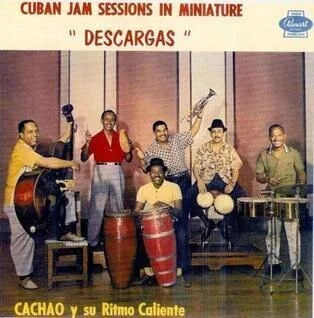
Cachao’s Cuban Jam Sessions in Miniature, one of the Descargas Cubanas records Tata played on.
1) “Descarga Cubana,” from Descargas Cubanas by Cachao 1957 | As mentioned earlier, this track is a must know for all percussionists interested in the Afro-Cuban tradition. Check out how Tata plays a solo phrase idea and then returns to the marcha before his next idea, an improvisational approach that would later become employed by countless percussionists.
2) “La Mulata Rumbera,” from El Marqués Del Marfil by Peruchin 1954-1965 | From a similar era as the previous Cachao track, this features Tata’s super swinging and steady time-keeping and accompaniment, as well as a beautiful conga solo that showcases Tata’s tasteful improvisation and technical prowess.
3) Afternoon Descarga Havana, on Congahead Youtube Channel 1979 | This impromptu descarga features the all star cast of Tata Güines, singer Mercedita Valdés, bassist Cachaito, drummer Guillermo Barreto, and Johnny Dandy Rodriguez on bongos. Hearing the conversation and interaction of these master musicians jamming along freely, is an absolute joy.
4) Presentación, from Pasaporte, by Tata Güines 1994 | This song opens with a free form or “open” solo by Tata Güines, fully displaying his incredible creativity, fluidity, technique and sound. You can hear the influence of Tata Güines on Miguel “Anga” Diaz who follows Tata with an open conga solo of his own.
5) “Chano Pozo” from Carnets de Revolución, by Various Artists 2004 | For a more recent recording of Tata, from his later life (with much clearer audio) this song has a legendary Tata solo. You can really hear the influence of rumba quinto in Tata’s playing as well as his creative and thematic development, and his ridiculously clear and powerful sound.
Timeline
1930Born June 30 in Güines, Cuba
1948Moves to Havana as a full-time musician
1957Descargas Cubanas with Cachao; moves to New York
1958Founding member of the Quinteto Instrumental de Música Moderna
After 1959Settles back in Cuba
1994Pasaporte, with Miguel “Anga” Diaz
1999Ancestral Reflections with Frank Emilio Flynn's Los Amigos
2004Order of Félix Varela
2006First percussionist to win Cuba's Premio Nacional de Música
2008Dies February 4, at 77
Awards & Recognition
In 2006 Tata became the first percussionist to receive Cuba's Premio Nacional de Música, the country's highest music award. Before that came the Alejo Carpentier Medal in 2002 and the Order of Félix Varela in 2004, and Havana's Instituto Superior de Arte gave him its Diploma al Mérito Artístico. He played on Bebo Valdés and Diego El Cigala's Lágrimas Negras, which won Best Traditional Tropical Album at the 2004 Latin Grammys, and was a featured soloist on La Rumba Soy Yo, the 2001 Best Folk Album winner.
Legacy
The Guardian called him "the last of Cuba's old-time conguero percussionists, a legend on and off the island." His most renowned disciple, Miguel “Anga” Diaz, carried that influence into his own international recording career. Tata kept playing almost to the end: in October 2007, a few months before his death, he performed with the flamenco singer Diego El Cigala at Seville's Teatro de la Maestranza.
In Cuba his music still has a festival of its own. The Festival Cuba Rumba Tata Güines in Memoriam reached its 16th edition in 2024.
From homemade drums to redefining the conga, Tata's story started with just an ear and the will to play. Yours can start today. Study with Grammy-winning percussionists and Latin music legends inside CongaChops.
Start your 7-day free trialRisk free. Cancel anytime.
More Percussion Profiles
 Chano Pozo
 Carlos “Patato” Valdés
 Armando Peraza