
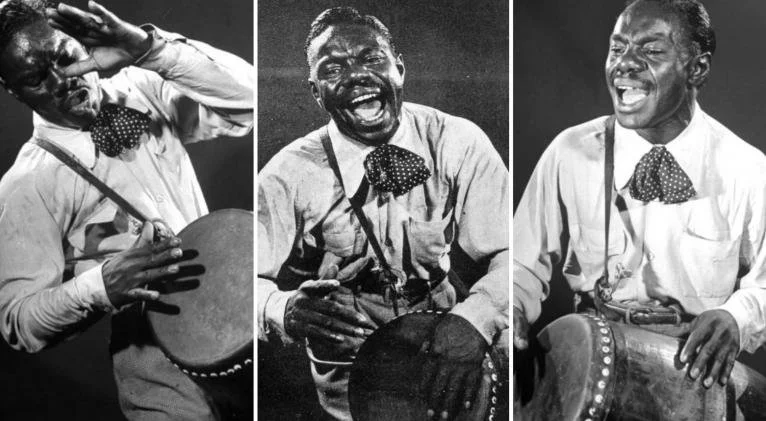
Chano Pozo (1915–1948) lived only 33 years, but his impact on Latin music and jazz was seismic. A Cuban percussionist, composer, singer, and dancer rooted deep in the Afro-Cuban religious and folkloric tradition, Pozo arrived in New York in 1947 and within months had co-created a new musical language alongside trumpet giant Dizzy Gillespie — one that would come to be known as Latin jazz, and that would set the course of Afro-Cuban percussion for generations to come.
FROM THE STREETS OF HAVANA TO CARNEGIE HALL
Luciano Pozo González was born on January 7, 1915, in the Vedado neighborhood of Havana, into circumstances defined by poverty and hardship. His mother died when he was eleven, and his early years were spent in some of the toughest barrios of the city, where survival on the streets was a formative education of its own. A stint in a youth reformatory in Guanajay, where he honed his drumming skills alongside learning to read and write, only deepened his connection to percussion. It was also during this period that he became a devotee of Santería, an Afro-Cuban religion rooted in the Yoruba traditions of West Africa — a spiritual foundation that would shape his musical identity for the rest of his life.
By the late 1930s Pozo had become the most sought-after rumbero in Havana, leading his own comparsa — the competitive street percussion and dance troupes that were the lifeblood of Carnival — and winning top prizes for his compositions. His reputation grew beyond the street: by 1941 he was performing with the orchestra at the Hotel Nacional, one of Havana's most prestigious venues, and composing songs that were being recorded and performed by some of Cuba's biggest names, including Miguelito Valdés and Machito's Afro-Cuban Boys. In 1947, with the encouragement of Valdés, he made the move to New York City.
His arrival was immediate in its impact. After recording sessions with Arsenio Rodríguez and Valdés, and a brief period working with Machito's band, he was introduced to Dizzy Gillespie by the legendary Mario Bauzá. The two men shared no common language — Pozo spoke no English, Gillespie no Spanish — but their musical connection was instantaneous. On September 29, 1947, just weeks after they met, Pozo appeared with Gillespie's big band at Carnegie Hall, performing the suite “Cubana Be, Cubana Bop” in what is widely considered a milestone event in the development of Latin jazz. Later that year they recorded “Manteca,” which became one of the most celebrated compositions in jazz history. It would prove to be among the last recordings of Pozo's life. On December 2, 1948, at the age of 33, he was shot and killed in a bar on 111th Street and Lenox Avenue in Harlem.
A TRADITION TRANSPLANTED
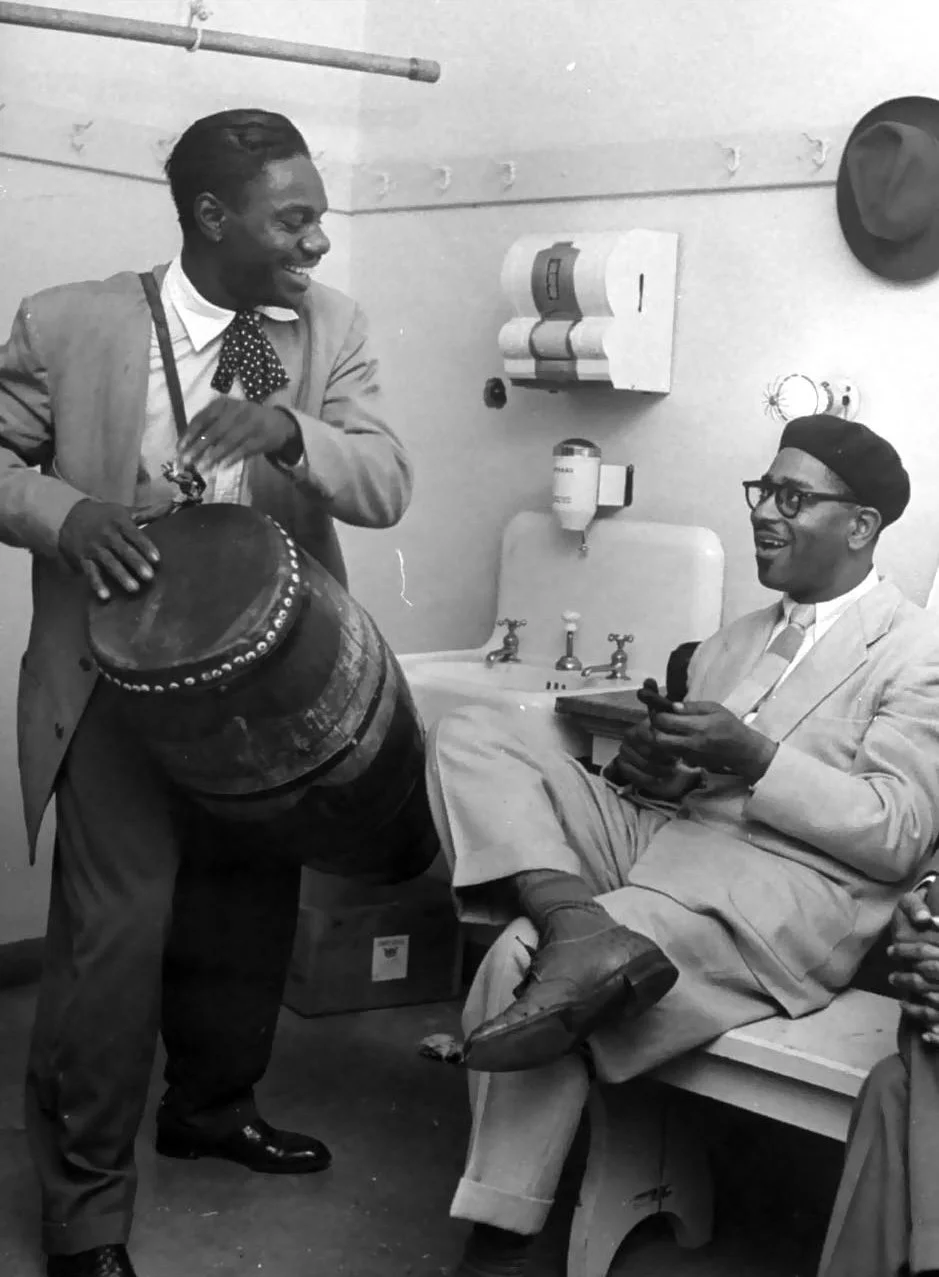
Chano Pozo & Dizzy Gillespie
What Chano Pozo brought to American music was something that had never been heard in that context before: the full weight and depth of the Afro-Cuban religious and folkloric percussion tradition, transplanted intact into the jazz idiom. His roots in rumba, guaguancó, and the sacred rhythms of the Abakuá secret society gave his playing a spiritual and rhythmic authority that was unlike anything jazz audiences had encountered. He performed at the front of the orchestra rather than behind it — singing, dancing, and playing simultaneously — and the visceral impact of his presence was transformative.
His collaboration with Gillespie did not merely produce a handful of celebrated recordings. It opened a door that could never be closed again. After Pozo, bandleaders across jazz and popular music scrambled to incorporate Afro-Cuban percussion into their ensembles, and a direct line runs from his Carnegie Hall debut through the entire subsequent history of Latin jazz and salsa — through Ray Barretto, Mongo Santamaría, Armando Peraza, Cándido Camero, Tata Güines, and every conguero who followed. As Gillespie himself acknowledged without hesitation, Chano Pozo taught him the fundamentals — and after Chano Pozo, everybody started getting congas.
SELECTED RECORDINGS
1947 – Cubana Be, Cubana Bop (Dizzy Gillespie Orchestra): The Carnegie Hall suite that announced the arrival of Latin jazz on the American stage.
1947 – Manteca (Dizzy Gillespie): The most celebrated collaboration between the two, and one of the most influential recordings in jazz history.
1947 – Tin Tin Deo (Dizzy Gillespie): Co-written by Pozo, this became another enduring standard of the Cubop repertoire.
1947 – Afrocubano Rhythm 1, 2, 3 and 4 (Spanish Music Center): Produced by Gabriel Oller, these are considered the first commercial recordings of rumba, columbia, guaguancó, and abakuá — a primary document of the folkloric tradition Pozo carried with him to New York.
AWARDS & RECOGNITION
Though his life was cut short before the era of major music awards, Chano Pozo's influence has been formally recognized many times over in the decades since his death. He was inducted into the inaugural class of the International Latin Music Hall of Fame in 1999, alongside fellow pioneers Tito Puente, Celia Cruz, Machito, and Arsenio Rodríguez. “Manteca” remains a foundational standard in the jazz repertoire, performed and recorded by generations of musicians since, and Pozo is widely credited by historians and musicians alike — including Gillespie himself — as the single most important figure in the birth of Latin jazz.
LEGACY
Chano Pozo's death at 33 cut short what might have become an even larger career, but the door he opened in less than two years in New York has never closed. Every conguero who followed him into jazz and popular music — Ray Barretto, Mongo Santamaría, Armando Peraza, Cándido Camero, Tata Güines, and countless others — walked through a path Pozo carved first. His collaboration with Gillespie remains one of the most studied chapters in jazz history, not because of its length but because of how completely it changed what was musically possible. More than seventy-five years after his death, “Manteca” is still performed on stages around the world, and Chano Pozo's name remains synonymous with the moment the conga drum entered the American musical mainstream for good.
Chano Pozo's story is the origin of everything that followed in Latin percussion. If it has you curious about the instrument at the root of it all, CongaChops.com is where to start.

START YOUR FREE TRIAL TODAY