
Francisco Aguabella (1925–2010) was one of the most revered Afro-Cuban percussionists ever to bring the sacred and secular drumming traditions of Matanzas to the world stage. A master of both the conga drum and the sacred batá, he spent more than five decades moving between the ceremonies of Santería and the concert stages of Latin jazz, rock, and pop — a living bridge between West Africa, Cuba, and North America whose depth of knowledge led Dizzy Gillespie to call him "the John Coltrane of the conga drums."
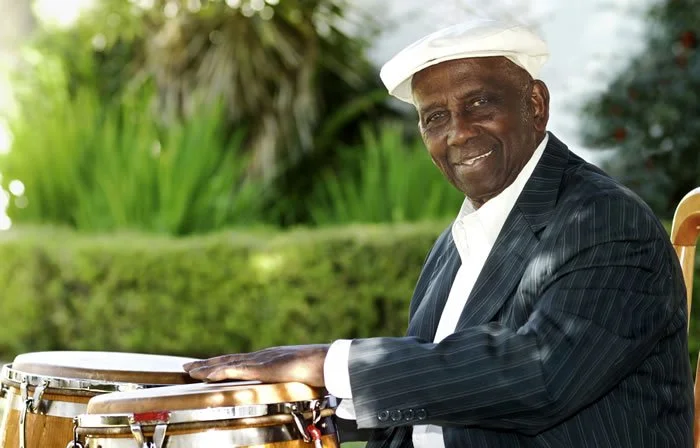
Photo by Tom Pich
THE DRUMS OF MATANZAS
Francisco Aguabella was born on October 10, 1925, in Matanzas, Cuba — a city on the island's northern coast known as one of the most profoundly African places in the Americas, where the descendants of Yoruba, Calabar, and other West African peoples kept their rhythmic and spiritual traditions remarkably intact. Aguabella often said that in Matanzas the drums were inescapable, as woven into daily life as baseball, heard everywhere from street-corner rumbas to sacred ceremonies. Drawn to percussion from an early age, he was initiated into several distinct Afro-Cuban drumming traditions — batá, iyesá, arará, olokún, and abakuá — and grew up immersed in rumba as an everyday, spontaneous expression of community life rather than staged entertainment.
His deepest calling was the batá, the sacred double-headed hourglass drum central to the ceremonies of Santería. As a young man he was first placed at the batá by the legendary Esteban "Cha Cha" Vega — who set the small okónkolo drum on his lap — and came up within the revered Matanzas drumming lineage of Pablo Roche "Okilapa," formally initiated into the sacred añá tradition around the age of fifteen. Aguabella became an olú batá — a fully initiated master authorized to play the sacred fundamento drums essential to Santería initiation ceremonies, a role he would carry with profound seriousness for the rest of his life, maintaining a lifelong devotion to his patron saint, Santa Bárbara (Changó). His standing in this sacred tradition was singular: before 1980, Aguabella and his friend Julito Collazo were the only two olú batá in the entire United States who had been initiated to perform batá fundamento, the most sacred form of the tradition. Before leaving Cuba he worked the cabaret circuit as well, drumming in the nightclub bands of Havana and Matanzas and absorbing the secular styles that would later define his crossover career.
His path to the wider world came through the pioneering African American dancer and ethnomusicologist Katherine Dunham, who traveled to Cuba in search of authentic folkloric musicians for her company. So taken was she with Aguabella's drumming that she invited him to join her troupe, and in the early 1950s he left Cuba to perform with the Dunham company — including an appearance in the Shelley Winters film Mambo (1954), filmed in Italy, and extensive touring through Europe, South America, and Australia. Homesick and initially reluctant, he was famously joined on the tour by his friend and fellow batá master Julito Collazo, who surprised him aboard ship. After years of touring with Dunham, Aguabella settled permanently in the United States by 1957, making his home in California — first the Bay Area, later Los Angeles — where he would live and work for the rest of his life.
THE JOHN COLTRANE OF THE CONGA DRUMS
What set Francisco Aguabella apart from nearly every other percussionist of his generation was the sheer depth of his rhythmic knowledge. As a master drummer trained in the Matanzas tradition, he carried a repository of sacred and folkloric rhythms that few others in the United States possessed — and he guarded the distinction between the sacred and the secular with great care, drawing on the spiritual power of the batá while never treating the ceremonial drums as mere entertainment. It was this combination of virtuosity and profound cultural knowledge that led Dizzy Gillespie to famously describe him as "the John Coltrane of the conga drums," and led Afro-Cuban historian John Santos to name him part of the first echelon of drummers responsible for everything that came after.
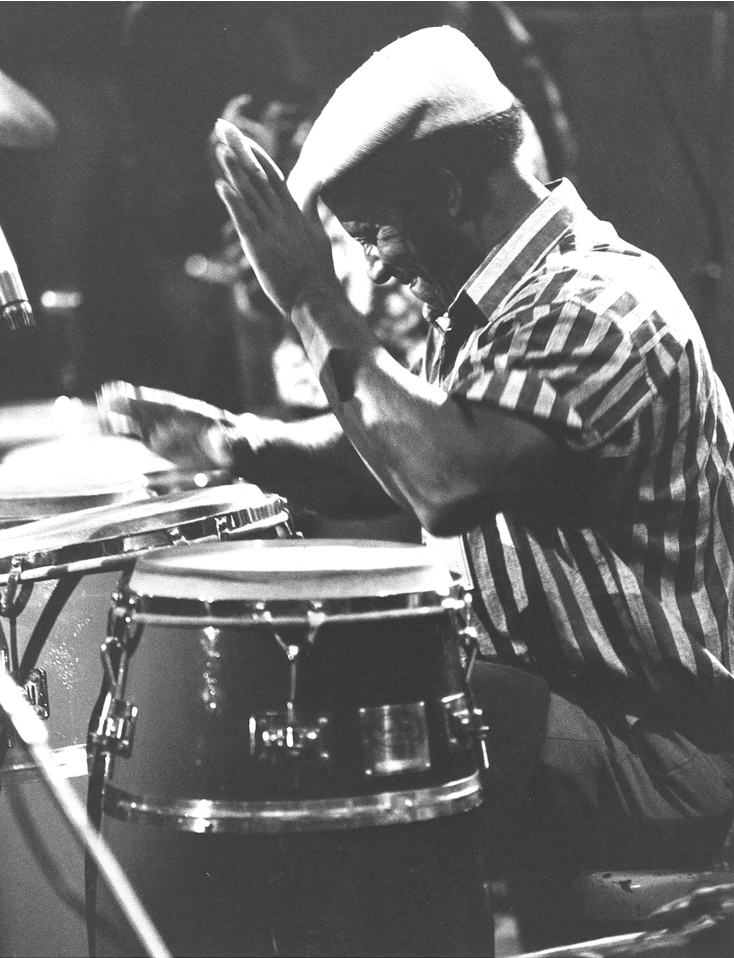
That authority made him one of the most sought-after percussionists in American music. It was Chano Pozo himself — the man who first brought Afro-Cuban drumming to American jazz — who reportedly recommended Aguabella to Dizzy Gillespie. As a sideman and session player he moved effortlessly across genres — recording and performing with Tito Puente, Mongo Santamaría, Eddie Palmieri, Cachao, Cal Tjader, and Gillespie in the Latin and jazz worlds; with Peggy Lee (with whom he toured for seven years), Frank Sinatra, and Nancy Wilson in pop; and with Carlos Santana, The Doors, and Weather Report on the rock and fusion side. His playing anchors some of the most important Afro-Cuban records ever made, including Mongo Santamaría's Yambú — one of the first albums to introduce North American listeners to the rhythms of Santería — and Eddie Palmieri's Lucumi, Macumba, Voodoo.
In the early 1970s he brought his congas to the San Francisco Latin rock band Malo, appearing on their run of Warner Bros. albums and contributing original compositions — "Helá" on Dos (1972), "Merengue" on Evolution (1973), and "A la Escuela" on Ascención (1974). He was also an accomplished composer in the Latin dance tradition, writing two of the best-known mambos in Tito Puente's book — "Complicación" and "Agua Limpia Todo" — both recorded by the Puente orchestra during the golden age of the mambo. On rare occasions he even stepped over to the timbales, but it was always the conga and the batá where his genius lived.
SELECTED RECORDINGS
1977 – Hitting Hard (Epsilon Records): Aguabella's rare-groove masterpiece — a street-style fusion of Latin jazz, salsa, and funk featuring fellow Cuban percussion great Armando Peraza. Long a prized collector's item, it was rediscovered by acid-jazz fans and reissued on Cubop/Ubiquity in 1999.
1999 – Agua de Cuba (Cubop/Ubiquity): A glorious late-career mix of Afro-Cuban grooves and Latin jazz that proved the uniqueness of his Matanzas-bred rhythmic sensibility.
2002 – Cubacan (Cubop): A mature, deeply grooving Latin jazz recording from his final creative period.
2002 – Cantos a los Orishas (Pimienta): A sacred recording of Aguabella with his batá drums, documenting the ceremonial Santería tradition he devoted his life to preserving.
2004 – Ochimini (Cubop): One of his final recordings as a leader, fronting a hot nine-piece Latin jazz ensemble that balanced fiery tradition with mellow sophistication.
AWARDS & RECOGNITION
In 1992, Francisco Aguabella received the National Heritage Fellowship from the National Endowment for the Arts — the United States' highest honor for a traditional artist — in recognition of his role in preserving America's cultural diversity. He was also awarded the Durfee Foundation's Master Musicians' Fellowship and received recognition from the Los Angeles County Arts Commission. His life and artistry were the subject of the acclaimed 1995 Les Blank documentary Sworn to the Drum, and for many years he taught Afro-Cuban drumming at UCLA within the ethnomusicology department, passing his knowledge to a new generation.
LEGACY
Francisco Aguabella died on May 7, 2010, in Los Angeles, at the age of 84, following a cancer-related illness — just days before he was scheduled to perform as one of The Conga Kings alongside Cándido Camero and Giovanni Hidalgo in New York. He left behind a legacy few percussionists can match: a body of sacred and secular knowledge carried intact from Matanzas across more than half a century, preserved on record, in ceremony, and in the countless students and colleagues he mentored. As John Santos observed, Aguabella belonged to the first echelon of Afro-Cuban master drummers who came to America and made possible everything that followed — a true guardian of the tradition.
Francisco Aguabella's story is a reminder that the conga drum is rooted in something far deeper than technique— a living tradition carried across generations and oceans. If his journey has you inspired to explore that tradition for yourself, CongaChops.com is the place to begin.
START YOUR FREE TRIAL TODAY