
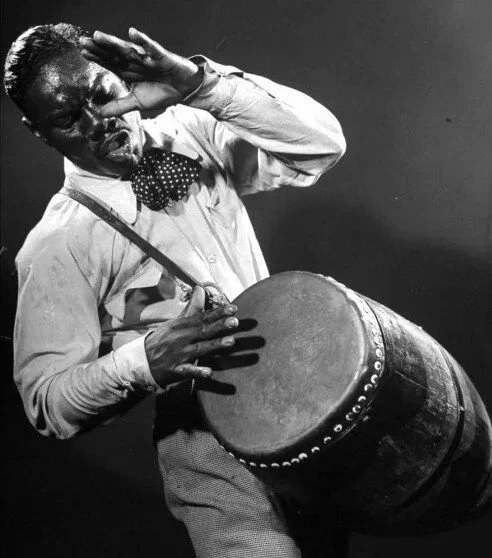
Along with learning how to play the conga drums, or any instrument for that matter, it’s important to have a general idea about where those instruments come from, and how they’ve evolved over time. So I want to give you a brief rundown of some super interesting and lesser-known facts about the origin of the conga drums, and of course, if you have questions about getting started learning how to play the congas, feel free to click here and check out a free preview of our Congas 101 Course.
WHAT IS A CONGA DRUM?

The conga is a narrow, single-head hand drum that comes in a variety of heights and diameters. The drums are typically played in sets of one, two, or more drums. Traditionally, early makers used barrel-making methods, and some drums were built from repurposed barrels. Modern congas are commonly made of one of a variety of woods, or of a one or two-piece fiberglass shell. Nolan Warden, in his history of the conga, describes early congas with cowhide or mule-hide heads tacked to the shell, a common technique in the construction of a variety of African drums. Today’s congas still use skin from cow, water buffalo, steer, and other animals, in addition to synthetic heads. The conga’s shell is made from a variety of steam-curved, staved wood depending on the manufacturer and model of the conga drums. Some congas are still carved from a single piece of wood, in the case of some high end artisan drum makers, very much in line with the African drumming tradition. The hardware nowadays also features a mechanical tuning system, that secures a head to the top of the drum.
The conga drum is at the cornerstone of countless Latin rhythms, and has helped Latin percussion as a whole, become extremely popular in many musical genres from all over the world. The conga is of Afro-Cuban origin. In Cuba, the drum is usually called the tumbadora. The conga player his or herself is referred to as a conguero or conguera.
THE ORIGIN OF THE CONGA DRUMS
The conga developed in Cuba from several African drumming traditions, including those of Bantu-speaking and Yoruba communities. Rumba took shape during the nineteenth century in communities of African descent in Havana and Matanzas, and the conga developed alongside rumba and other drum-centric music.
Likely influences include the Bantu-derived yuka and makuta drums and the Lucumí bembé drums. The origin of the name “conga” itself is disputed.
Rumba, which has its roots in the poorer urban neighborhoods of cities like Havana and Matanzas, was central to the development of the tumbadora and its place in Cuban music. In the 1940s, Arsenio Rodríguez helped establish the tumbadora in the son conjunto, and the conga went on to make an enormous impact on American jazz music in the 1940s. These Cuban traditions helped shape salsa, which developed in New York through the 1960s and boomed in the 1970s.

Dizzy Gillespie Big Band 1940s
A major moment for the conga in jazz came in 1947, when the legendary Chano Pozo, who had played in Havana’s carnival comparsas, joined Dizzy Gillespie’s big band in New York. That September 29 he was out front at Carnegie Hall. That December, Gillespie’s orchestra recorded “Manteca,” credited to Chano Pozo, Dizzy Gillespie and Gil Fuller.
During the 1940s and 1950s, Cuban congueros including Mongo Santamaría, Cándido Camero, Carlos “Patato” Valdés and Armando Peraza helped expand the instrument’s audience in the United States. You can read about each of them in our Percussion Profiles.
THE EVOLUTION OF THE CONGA DRUM

Traditionally, conga drums were non-mechanically tuned percussion instruments. The drum heads were secured to the staved wooden body with tacks or nails. So in order to change the pitch, the skin needed to be either moistened or heated. Moistening the drum head lowered the pitch, and heating it allowed for achieving a higher pitch.
Mechanical tuning became widespread during the 1950s, with a securable rim, lugs, and adjustable lug nuts which allowed the conga player to tune the drum with much more precision. This enabled the congas to be tuned to specific pitches with more accuracy, and gave way to a new wave of contemporary conga players with a more conscious melodic approach to tuning and playing the drums. Accounts differ on who first developed mechanical tuning for congas. Peraza credited Cuban drum maker Gonzalo Vergara with developing conga tuning hardware, according to percussionist Alex Pertout’s historical account.
At the time, most congueros played one drum each. Players such as Cándido helped change that. In a 2008 NEA interview, Cándido said he was the first to play three congas. He tuned them to different pitches to play melodies. Patato also explored the melodic possibilities of multiple congas, tuning them to different pitches. According to Blue Note’s biography of Patato, the LP Patato Model congas went on sale in 1978.
Timeline
Colonial CubaAfrican drumming traditions take root and develop on the island
19th centuryRumba develops in Havana and Matanzas
1940Arsenio Rodríguez records “El pirulero no vuelve más” with a conga in his conjunto
1947Chano Pozo joins Dizzy Gillespie; Carnegie Hall in September, “Manteca” in December
1950sMechanical tuning becomes widespread
1960s–1970sSalsa develops in New York and booms
1978LP Patato Model congas go on sale, according to Blue Note
FREQUENTLY ASKED QUESTIONS
Where did the conga drum originate?
The conga developed in Cuba from African drumming traditions and became closely associated with rumba.
What are conga drums made of?
Modern congas commonly have wooden or fiberglass shells, with animal-hide or synthetic heads.
Is a conga the same as a tumbadora?
Yes. Tumbadora is a common Cuban name for the drum known internationally as a conga.
What do you call a conga player?
A conguero or conguera.
What’s the difference between congas and bongos?
Congas are tall, individual hand drums. Bongós are a joined pair of smaller hand drums, traditionally held between the knees. You can read more in A Brief History of the Bongos.
The conga drum evolved from deep African and Cuban roots into one of the world’s most recognizable percussion instruments. Explore its sound, technique and musical vocabulary inside CongaChops.
Start your 7-day free trialRisk free. Cancel anytime.
Learn to play