
If there's one topic that trips up almost every percussionist at some point — beginner and pro alike — it's the clave. You can learn the pattern in five minutes, but actually feeling which direction it's flowing in, and why, is something that takes real time to internalize. This post pulls together the core ideas in one place, so you have a single reference to come back to as it clicks.
First off, just so you can have a foundation for understanding the clave itself, make sure to check out Lesson 8 on Understanding the Clave from our Conga Fundamentals Course (preview the course here). Whether you're a member or not, also watch Quick-Tip Lesson 1 (free), which covers son and rumba clave and the 2-3 and 3-2 directions.
The two main concepts we need to have in mind for what I'll lay out in this post are: the common types of claves we'll use — rumba clave and son clave — and the concept of direction/flow 3-2 or 2-3.
Once you've watched that lesson you'll have an idea of what the son and rumba clave are, how to count them, and what they look like on paper. What I'll share below aren't necessarily "rules" but they will serve as guidelines.
Son clave vs rumba clave, and why the clave flips
Now that you understand the main differences between the claves you know that the rumba clave has a note on the "and" of 4 on the 3 side, while the son clave has a note on beat 4, on the 3 side. That aside, the claves are identical as far as the way they are written, and will always be binary (two-sided) patterns.
Unless otherwise noted in a particular arrangement, the clave will always be flowing in the same direction. Because it is a 2-bar phrase, as long as we have even numbered phrases in a song or arrangement, the clave direction we begin with will stay consistent throughout. However, if an arrangement has, say, a 7- or 9-bar phrase, traditionally speaking the clave will "flip" because we are now changing which side of the clave will be serving as a starting point for counting purposes. (See the 8-bar and 9-bar phrase examples below.)
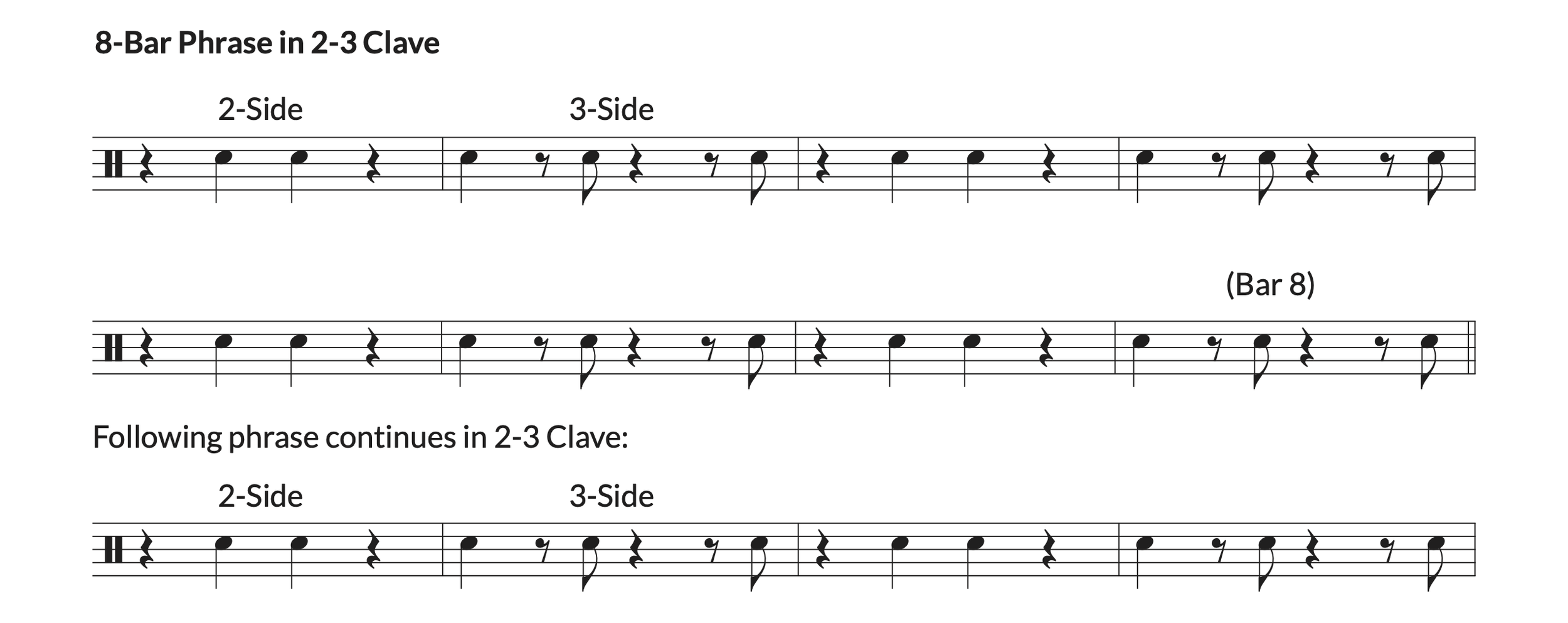
An 8-bar phrase in 2-3 clave. The next phrase continues in 2-3.
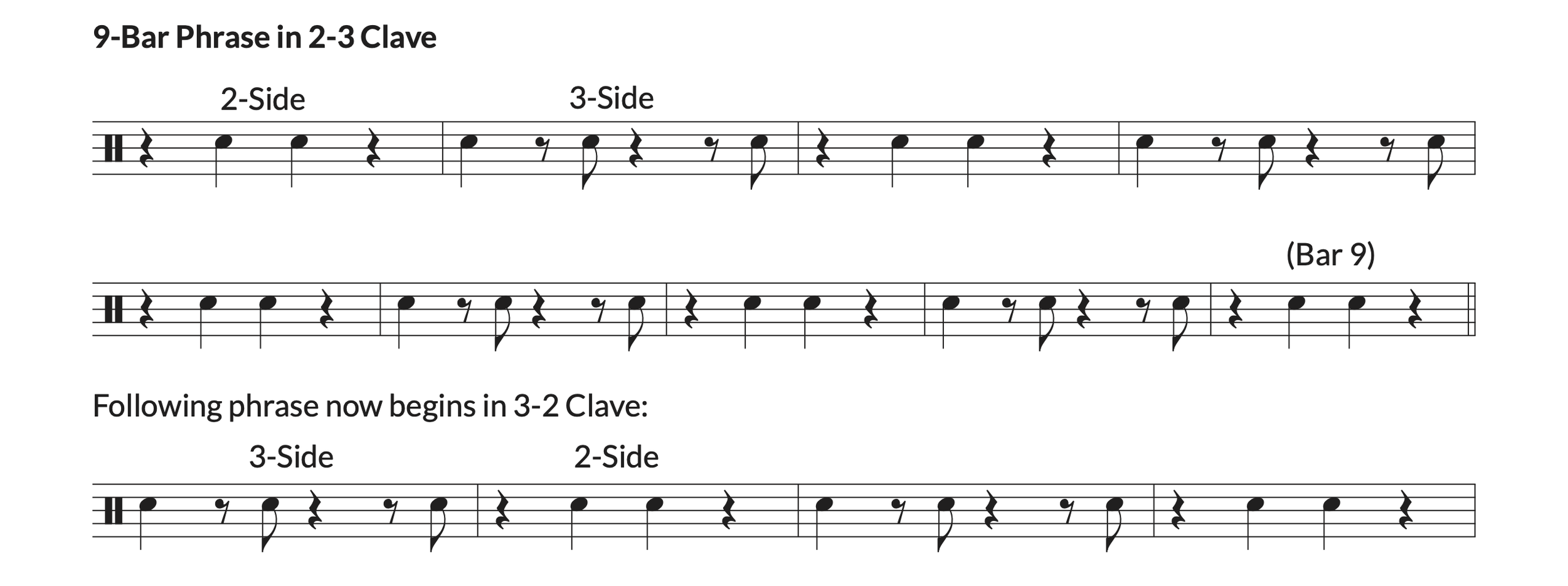
A 9-bar phrase starting in 2-3 clave. The next phrase begins in 3-2.
In the examples above, if we start our 8-bar phrase in 2-3, the next phrase will continue to be in 2-3. If we start our 9-bar phrase in 2-3, the next phrase will be in 3-2.
This is pretty uncommon in folkloric music, but you will hear it used from time to time by arrangers in the salsa and Latin jazz styles. The Sonora Ponceña is an example of a group that used this quite often, where the verse of a song would be in the 2-3, and the chorus would be in 3-2, all because they took away or added one bar in a prior section.
Which clave to use where
In a traditional sense the rumba clave is used for rhythms and styles related to rumba, and the son clave is used for rhythms related to, you guessed it, son. That being said, nowadays they are used interchangeably, as long as the direction/flow is correct. You can clap 3-2 rumba clave OR 3-2 son clave with anything in the 3-2 direction and technically it will work.
However, the reason that the 3-2 rumba clave feels more natural over guaguancó for example, is because placing the last stroke on the "and" of 4 makes it easy for us to feel the clave in both 4/4 or cut time (binary) AND 6/8 or 12/8 (ternary), as I explain in the lesson I mentioned at the beginning of this post. Being that a lot of the phrasing used in guaguancó is happening in binary and ternary feels simultaneously, it feels natural to use the rumba clave.
As for the son clave, the phrasing in the son style is considerably more often in a binary feel, and son is played at slower tempos than guaguancó, so the son clave feels natural here. Other than that, the main thing that affects which clave we use is tempo. When we get to a certain speed, when playing in 4/4 or cut time, it becomes natural for us to feel phrasing in binary AND ternary as we would in the guaguancó.
So most of the time, if we have something above 100 BPM cut time, it will feel very natural to use the rumba clave. Anything below 90 BPM will feel comfortable to use the son clave. This is not a rule, but it will apply on many occasions, and you will see it reflected in modern salsa and timba, where, as mentioned, rumba and son clave are used interchangeably.
The "feel" of the clave also constantly lives somewhere between a binary grid and a triplet grid. There are times when it is more explicitly played with a more binary feel and vice versa. When you get into faster tempos like that of a rumba guaguancó, what will distinguish the feel of the clave are the notes being played in between — that is to say the phrasing and feel of the rest of the drums.
How to tell which side of the clave you're on
As far as what determines which side of the clave you start on, it's the melodic rhythm of the main melody of a song/section— it could be a singer or an instrument OR in the case of a percussion ensemble the melodic rhythm of the drums. As you can gather from the guaguancó lesson in our Groove Toolbox course— the base melody of the tres golpes pattern only happens on one side of the clave, the 2 side. So we know that when we hear this as part of the base rhythm, we are on the 2 side of the clave. If it's played continuously as part of a base rhythm on the 3 side of the clave, we know we are "cruzado," or "crossed," which means we are "playing/flowing" against the clave or playing something on the "incorrect side" of the clave. This is not to be confused with purposefully playing in counterpoint to create tension. It's CRUZAO! lol Of course in a non-traditional setting, like a pop setting there's nothing wrong with playing crossed as long as it serves the music. But it has to be done willingly, in a space where we are aware that we are playing a particular groove like this on purpose, mainly because we have taken it out of its traditional context and are simply using the melody of the drums as inspiration for a groove that complements the song and the other instruments.
Training your ears
Now we get to the actionable part, how to train our ears and minds. First we have to be aware that all of the rhythms based on the clave will almost always have two sides as well. These two sides correspond with the clave. So in the case of the cascara, contracampana, or bongo bell patterns (which work with both rumba and son claves), we can play these in 3-2 or 2-3 direction, and this HAS TO line up with the direction of the clave for it to feel good. Check out the lessons on cascara and contracampana from the Timbale Fundamentals Course. The more rhythms we learn, and understand their relation to the clave, the easier it becomes for us to identify which side of the clave we're on. The same goes for the tumbao pattern, bongo lock, quinto phrasing and solo phrasing, and even piano, bass, and horns.
A great way to start working on this is with any of our Afro-Cuban loops (members), which ALL have the clave being played throughout. Start with some slower tempo loops— maybe the Percussion-Only Rumba Guaguancó Loop at 90 BPM, and clap the clave along as you hear it. Start with the loop without congas first. Once you can do this, try to clap the clave and listen to the other percussion parts, learn them, and analyze where they fit with respect to the clave. Then do the same thing with the same loop that has the conga pattern. Move on to doing the same thing with some of the Percussion-Only Tumbao Loops, that have a two-bar (or longer) tumbao phrase. Then use one of the Son Loops with full rhythm section, listen to the cowbell, piano, and so on.
Learning different rhythms from different instruments and understanding how they lock in with the clave, will be the key to knowing which direction the clave flows in, regardless of whether it's actually being audibly played. All of the instruments you hear on our loops are always playing "in clave" which is to say they lock up with the clave and are on the "correct" side at all times. The more you listen to music that is in clave, analyze how the parts work together, the easier it will become for you to discern which clave and most importantly in which direction it's being played.
Who decides the direction, and why it works the way it does
Afro-Centric music in general is all by ear! Western notation is an approximation and does not exist naturally in any folkloric music. Syllables or sounds stemming from an oral tradition have been translated to western musical notation as a learning tool of course.
As far as what governs when creating something, it really depends on how the composer/songwriter is thinking. Whether they clap clave and then apply a melody, or vice versa, sing a melody and then apply the clave — the guidelines are the same, what's mentioned above is the key. How certain rhythms and patterns work in tandem with the clave will let you know. By learning these patterns and phrases and how they work with the clave, you're essentially building your rhythmic vocabulary which will allow you to innately understand how the clave works on a deeper level.
As far as "why," it's a language, akin to harmonic cadences in music for example. Some things sound "diatonic" or native to a certain key or chord, others create dissonance. Knowing when and how to use these whether to sound "in" or "out" is much like the concept of clave. In the end it's just a language that is relatively structured. The same way we use letters and syllables in a specific way to create words, we use small rhythmic cells sometimes in a specific way, among other things, to create rhythms and phrases. In this case rhythms and phrases that have the clave as their basis.
Quick recap
What's the difference between son clave and rumba clave? The rumba clave has a note on the "and" of 4 on the 3 side, while the son clave has a note on beat 4, on the 3 side. That aside, the claves are identical as far as the way they are written.
Why can the clave flip from 2-3 to 3-2? If an arrangement has a 7- or 9-bar phrase, traditionally speaking the clave will "flip" because we are now changing which side of the clave will be serving as a starting point for counting purposes.
How does tempo affect the choice of son or rumba clave? This is not a rule. Most of the time, if we have something above 100 BPM cut time, it will feel very natural to use the rumba clave. Anything below 90 BPM will feel comfortable to use the son clave.
What can tell you which side of the clave you're on? The melodic rhythm of the main melody of a song or section, or in a percussion ensemble the melodic rhythm of the drums, can tell you which side of the clave you're on.
Further resources
The first lesson in our Quick-Tip Series explains in detail how to go about playing the tumbao in clave, one of the most important and practical concepts to help you further your understanding. It's free to watch.
Bottom line
Slow and steady wins the race! The more patterns, rhythms, rhythmic cells and phrases you learn and analyze with respect to the clave the easier it will become for you to start to hear it correctly, innately.
Learn about the clave and the rhythms and instruments that use it as a foundation, from congas and bongó to timbales, step by step inside CongaChops.
Start your 7-day free trialRisk free. Cancel anytime.